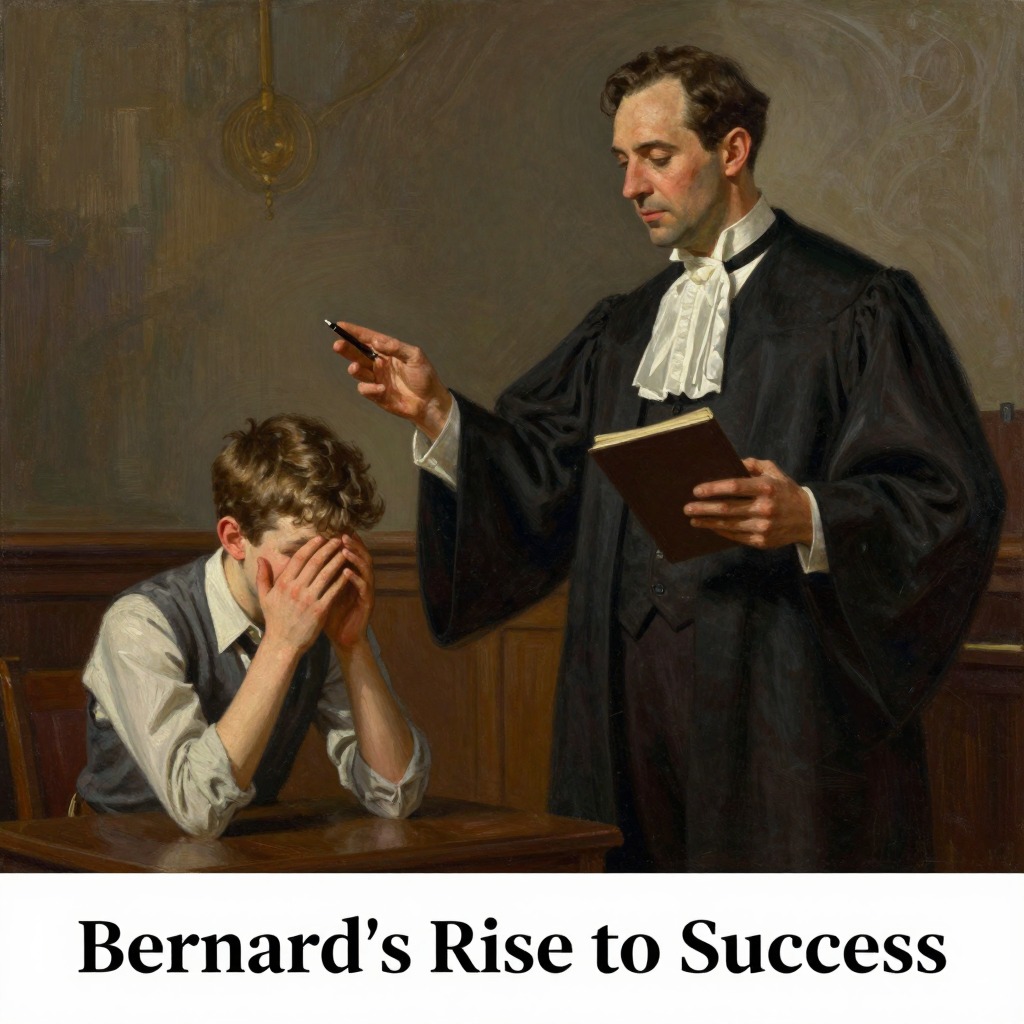
Bernard
Bernard is the son of Charley, the Lomans' next-door neighbor, and from boyhood he stands as a quiet, worried counterpoint to the flashy confidence of Biff Loman. Where Biff is built like an Adonis and coasting on personal attractiveness, Bernard is earnest, loyal, and anxious—a boy who wipes his glasses and frets over Regents exams. Willy Loman dismisses him as anemic and not "well liked," predicting that Bernard's bookishness will leave him behind in the business world. Yet Bernard's trajectory, from a nervous child carrying Biff's shoulder guards to a lawyer arguing before the Supreme Court, exposes the hollowness of Willy's philosophy and offers a different, more sustainable model of success.
Identity and Background
Bernard grows up next door to the Lomans, the son of Charley, a laconic, practical man who runs a successful business. As a boy, Bernard is earnest and loyal, a worried child who takes his studies seriously. He is first seen in knickers, trying to drag Biff away from play to study for the Regents, warning that Mr. Birnbaum will flunk him if he does not start studying math. Willy Loman dismisses Bernard as anemic and not "well liked," predicting that Bernard's academic diligence will not serve him in the business world. Bernard, however, persists in his concern for Biff, even carrying his shoulder guards to the big football game at Ebbets Field.
Arc Through the Plot
Bernard's presence in the play spans both past and present, marking the distance between Willy's fantasies and reality. In the remembered past, Bernard is a constant, anxious presence, trying to keep Biff on track for graduation. He reports that Biff flunked math and that the school will not graduate him, news that sends Biff to Boston and precipitates the crisis that shatters his relationship with his father. In the present, Bernard has matured into a quiet, self-assured young man. He is seen in his father's office, waiting for a train to Washington, D.C., where he has a case to argue. He carries tennis rackets, a detail that underscores his comfortable, successful life. When Willy encounters him, Bernard is polite but direct, and he gently presses Willy on the mystery of what happened in Boston that caused Biff to give up. Bernard's own success—arguing before the Supreme Court—is revealed almost as an aside, a fact he does not boast about, in stark contrast to Willy's constant self-promotion.
Relationships and Conflict
Bernard's relationship with Biff is one of boyhood friendship marked by an imbalance of power. As a child, Bernard is devoted to Biff, carrying his gear and trying to help him study, but he is also treated with casual condescension by the Lomans. Willy mocks Bernard's physique and predicts that Biff will surpass him in the business world because of his personality. Yet Bernard remains loyal, even after Biff's fall. In the present, Bernard asks Willy directly what happened in Boston, revealing that he has long been mystified by Biff's sudden collapse. He recalls that after Biff returned from that trip, he burned his prized University of Virginia sneakers in the furnace, and the two boys had a fist fight in the cellar, crying through it. Bernard's question—"What happened in Boston, Willy?"—is the closest anyone comes to naming the secret that has poisoned the Loman family. Bernard's relationship with his own father, Charley, is one of quiet respect and support, a contrast to the volatile, love-hate dynamic between Willy and Biff.
Change and Ending
Bernard's arc is one of steady, unglamorous achievement. He does not rely on being "well liked" or on personal magnetism; he works hard, studies, and earns his success. By the end of the play, he is a lawyer arguing before the Supreme Court, a fact that Willy finds both shocking and painful. Bernard's success is a living refutation of Willy's belief that personality and contacts matter more than substance. At Willy's funeral, Bernard is present, somberly dressed, standing with his father. He does not speak in the Requiem, but his presence underscores the contrast between the two families' fates. Bernard has inherited his father's practicality and decency, and he has built a life on the solid ground of hard work, not on the shifting sands of a salesman's dream.
Thematic Significance
Bernard embodies the alternative to Willy Loman's version of the American dream. Where Willy believes that being "well liked" is the key to success, Bernard demonstrates that diligence, integrity, and genuine competence are what ultimately matter. Willy dismisses Bernard as anemic and predicts that he will never succeed in the business world, but Bernard's quiet rise to the Supreme Court exposes the emptiness of Willy's philosophy. Bernard's success is not built on charm or contacts; it is built on the very things Willy scorns—study, discipline, and a willingness to work within the system. In this sense, Bernard serves as a moral and thematic foil, not only to Biff but to the entire Loman family's self-destructive pursuit of an illusory dream. His presence in the play is a constant, quiet reminder that there is another way, one that does not require a man to sell himself or to live on a smile and a shoeshine.